
What is MCP? Understanding Anthropic’s Open Standard
Every new AI tool your team adopts means another round of custom integrations — one for each data source, each with its own authentication, error handling, and maintenance burden. The Model Context Protocol (MCP) was built to solve exactly this problem [1].
On November 25, 2024, Anthropic announced MCP — an open standard designed to eliminate this integration fragmentation [1]. Created by David Soria Parra and Justin Spahr-Summers at Anthropic, MCP enables secure, two-way connections between AI-powered applications and data sources [1]. Unlike proprietary integration methods that lock developers into specific ecosystems, MCP is built as an open standard using JSON-RPC 2.0 as its foundation [2]. This architectural choice makes MCP language-agnostic and implementation-neutral, allowing any developer to build MCP-compatible clients or servers regardless of their technology stack.
The protocol specification uses date-based versioning, with the initial release (2024-11-05) establishing the core protocol and subsequent updates (most recently 2025-03-26) adding enhanced capabilities [2].
The Problem: Why AI Systems Need Better Context
AI systems have long suffered from a fundamental limitation: they’re trapped behind information silos and legacy systems. Despite remarkable advances in reasoning capabilities, large language models remain constrained by their isolation from the data that would make them truly useful in production environments. Every new integration — connecting an AI agent to a database, a document store, a version control system, or a third-party API — requires custom development work.
This creates what industry observers call the “M×N integration problem.” If you have M different AI clients and N different data sources or tools, you traditionally need M×N separate integrations [1]. Each connection requires custom code, individual security reviews, and ongoing maintenance. The result is a fragmented landscape where integration complexity grows exponentially.
The Model Context Protocol addresses this by replacing the M×N matrix with an M+N architecture [1]. Instead of building bespoke connections for every client-data source pair, developers can build one MCP server for each data source and one MCP client for each AI application. The standardized protocol handles the connections automatically, dramatically reducing both initial development effort and long-term maintenance burden.
How MCP Works: Architecture and Protocol Design
MCP follows a client-server architecture with three core components: MCP servers that expose data sources and tools, MCP clients that consume those resources, and the protocol layer that standardizes all communication [2].
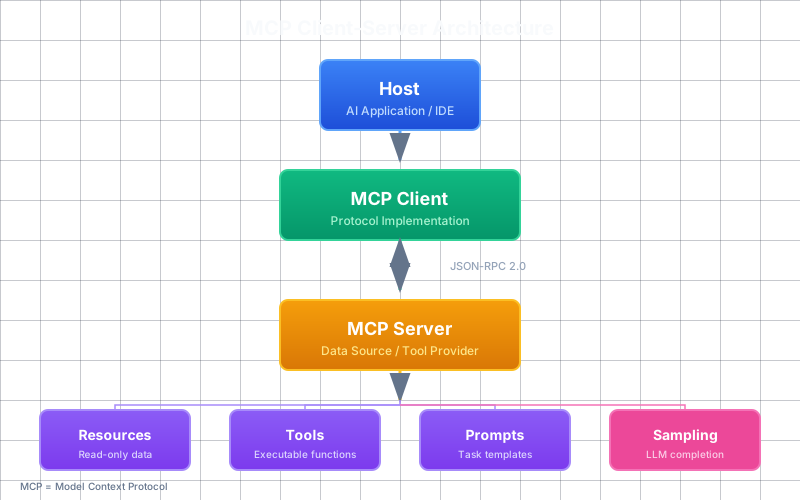 MCP client-server architecture showing Host → Client → Server connections with Resources, Tools, and Prompts primitives
The protocol layer is built on JSON-RPC 2.0, a lightweight remote procedure call protocol that provides structured request-response patterns, batch processing capabilities, and standardized error handling [2]. This foundation makes MCP transport-agnostic — it can work over standard input/output streams for local processes, HTTP with Server-Sent Events for remote connections, or WebSockets for persistent bidirectional communication [2].
MCP defines three key primitives that servers can expose [2]:
Resources are named data items that clients can read, containing either text or binary content. These might represent files, database records, API responses, or any other data an AI agent needs to access.
Tools are functions exposed by servers that clients can invoke. Unlike resources, tools must be explicitly enabled by clients — a security measure ensuring AI agents don’t execute arbitrary functions without operator approval.
Prompts are pre-defined templates stored on servers for specific tasks. These allow organizations to standardize common AI interactions, ensuring consistency across different client applications.
Beyond these three primitives, MCP defines Sampling as a bidirectional capability: servers can request LLM completions from clients, enabling sophisticated agentic patterns where a server uses the client’s AI capabilities [2].
When a client connects to a server, they perform capability negotiation through an initialization exchange [2]. Each party declares what features it supports, ensuring both sides understand the available functionality before operations begin.
The M×N to M+N Efficiency Revolution
The efficiency gains from MCP’s standardized approach are transformative. Consider a typical enterprise AI deployment: an organization running Claude for document analysis, a Python agent for data processing, GitHub Copilot for coding, and a support agent for customer service — each needing access to the same databases, document repositories, and third-party APIs.
In the traditional model, each connection is a custom development project — a different implementation for every AI client, separate updates whenever a schema changes, and individual security audits for every pair. Maintenance overhead compounds rapidly.
With MCP, the organization builds one MCP server for the database. Every AI client connects through the same protocol interface, security is enforced at the protocol level, and a schema change requires updating only the server — not every integration built on top of it.
Anthropic demonstrated this efficiency at launch by releasing pre-built MCP servers for Google Drive, Slack, GitHub, Git, Postgres, and Puppeteer [1]. Instead of thousands of developers building thousands of slightly different Slack integrations for their AI agents, the community can maintain one standardized server that works with any MCP-compatible client.
Real-World MCP Implementations: Block, Replit, Zed, and More
The most compelling evidence of MCP’s potential lies in its rapid industry adoption. Anthropic announced MCP on November 25, 2024, alongside six major launch partners: Block, Apollo, Zed, Replit, Codeium, and Sourcegraph [1]. Independent observers noted the fast community uptake, attributing it to the M+N efficiency argument [4]. Implementation details below are drawn from Anthropic’s launch announcement and the companies’ public statements at launch [1].
Block (formerly Square) is using MCP to build what they describe as “agentic systems that remove the burden of the mechanical so people can focus on the creative” [1]. Dhanji R. Prasanna, CTO at Block, stated: “Open technologies like the Model Context Protocol are the bridges that connect AI to real-world applications, ensuring innovation is accessible, transparent, and rooted in collaboration.” [1]
Apollo.io , a sales intelligence platform, was announced as a launch partner for MCP alongside Block, Zed, Replit, Codeium, and Sourcegraph at the November 2024 announcement [1].
Replit, the browser-based development environment, uses MCP to enable their AI agents to retrieve more relevant information around coding tasks [1]. According to Anthropic’s launch announcement, this integration produces “more nuanced and functional code with fewer attempts” by giving Replit’s AI features standardized access to external data sources while maintaining conversation context [1].
Zed, a modern code editor built with AI-native features from the ground up, uses MCP to enhance their AI-powered coding assistance [1]. Based on MCP’s stated capabilities at launch, the protocol can provide structured access to project context, documentation, and development tools — enabling an editor like Zed to maintain conversation context across different tools and data sources without building custom integrations for each one.
Sourcegraph, the code intelligence platform, integrates MCP to help their Cody AI understand code context at scale [1]. Based on MCP’s general capabilities, Cody can access repository metadata, code search results, and other code intelligence data through standardized interfaces — capabilities that would otherwise require bespoke integrations with each code host and tool in a developer’s workflow.
Codeium, an AI-powered code completion tool, uses MCP to provide AI agents with access to relevant code context, documentation, and development tools [1]. Based on MCP’s stated capabilities, the integration can enhance code suggestion quality by providing richer context through the standardized protocol rather than through custom-built connectors.
These implementations share a common pattern: each company faced the M×N integration problem as they scaled and adopted MCP as a standardized foundation rather than building custom integrations with every data source.
MCP vs. Plugins: Why the Protocol Approach Wins
The distinction between MCP and traditional plugin systems reveals why the protocol approach is gaining traction. Traditional plugins are typically opaque black boxes with language-specific bindings and tight coupling between host applications and extensions. Each plugin requires individual security review, and APIs vary inconsistently across different tools.
MCP represents a fundamental architectural shift. As a standardized protocol rather than a plugin framework, it offers several decisive advantages:
Language agnosticism means MCP implementations aren’t constrained to a single programming language. The JSON-RPC foundation enables servers in Python, clients in TypeScript, and integrations in Go or Kotlin to communicate without language-specific adapters [2].
Composable architecture allows multiple MCP servers to be chained and combined. A workflow might involve an MCP server for file access, another for database queries, and a third for web search — each operating independently but working together through the standardized protocol.
Observability through OpenTelemetry instrumentation is built into MCP’s design [2]. The OTel community has defined semantic conventions for MCP operations, enabling distributed tracing across agent workflows — a critical gap in traditional plugin systems where understanding cross-system behavior typically requires custom instrumentation.
Compared to function calling, MCP adds persistence, discovery, and standardization. Traditional function calling is stateless per conversation with no standardized mechanism for discovering what tools are available. MCP servers maintain state across interactions and expose discovery endpoints that let clients dynamically understand available capabilities [2].
The ecosystem growth reinforces these technical advantages. Official SDKs exist for TypeScript (the reference implementation), Python, Go, and Kotlin [3]. A growing registry of pre-built servers covers common enterprise systems [3]. Specification Enhancement Proposals (SEPs) provide governance mechanisms for protocol evolution [2].
Security Considerations for MCP Implementations
MCP implements a comprehensive security framework for connecting AI systems to data sources. The protocol includes OAuth 2.1 support for secure authorization flows, enterprise-managed authorization through identity providers, and client credentials flow for machine-to-machine authentication [2].
Capability negotiation during initialization ensures both parties understand security boundaries before exchanging data [2]. Tool execution requires explicit client opt-in — a deliberate design choice preventing AI agents from executing arbitrary server functions without approval [2]. Input validation and sanitization requirements are built into the specification [2].
SEP-1024 establishes consent requirements for local server installation — MCP clients must clearly surface what a local server will access and obtain explicit user approval before installation, preventing silent background installs of potentially privileged software [2].
Protection against prompt injection and other AI-specific attack vectors is also incorporated into the specification [2].
Practical Takeaways
- Start with one server. Pick your team’s most-used internal data source and build a single MCP server for it — that one server immediately serves every MCP-compatible AI client in your stack.
- Audit your current integration sprawl. Count how many custom connectors exist between your AI tools and data sources today. That number is your M×N baseline; MCP reduces it to M+N.
- Use the pre-built servers first. Anthropic released production-ready MCP servers for Google Drive, Slack, GitHub, Git, Postgres, and Puppeteer at launch [1]. Start there before writing custom servers.
- Enforce Tool opt-in from day one. MCP requires explicit client approval before any Tool is executed. Design your security policy around this gate early — retrofitting access controls onto a running system is significantly harder.
- Instrument with OpenTelemetry before you scale. MCP’s JSON-RPC foundation supports distributed tracing out of the box [2]. Instrument your first MCP server while the system is small — visibility is cheap now and expensive later.
Conclusion
MCP represents more than a technical specification — it marks an inflection point in how the industry approaches AI integration. The argument it makes is structural: standardization generates ecosystem-wide network effects that no proprietary approach can replicate. Each new MCP server makes every compatible client more capable, and each new client grows the incentive for the next [3]. Specification Enhancement Proposals (SEPs) give developers a formal channel to shape protocol evolution, keeping MCP’s roadmap anchored to production needs rather than a single vendor’s priorities [2].
For organizations building AI systems today, the cost of delay is the M×N sprawl MCP replaces. Teams that standardize early inherit every compatible server added to the ecosystem after them — for free.
Sources
| # | Publisher | Title | URL | Date | Type |
|---|---|---|---|---|---|
| 1 | Anthropic | Introducing the Model Context Protocol | https://www.anthropic.com/news/model-context-protocol | 2024-11 | Blog |
| 2 | MCP Project | MCP Specification | https://modelcontextprotocol.io | 2024-11 | Documentation |
| 3 | MCP Project | MCP GitHub Repository | https://github.com/modelcontextprotocol | 2024-11 | Documentation |
| 4 | Simon Willison | Notes on the Model Context Protocol | https://simonwillison.net/2024/Nov/25/model-context-protocol/ | 2024-11 | Developer Analysis |
Image Credits
| # | Description | Photographer | Source |
|---|---|---|---|
| 1 | Cover photo — abstract network of glowing connection points | Albert Stoynov | Unsplash |